
The common toad is one of only two toads native to the UK; the other toad is the natterjack, which is smaller than the common toad, much rarer, and tends to live in coastal areas, in sand dunes and sandy heaths. With photographs taken by Sally Murray, as she was preparing to clean out a plant pot in her garden near Ash Hill in Bishopsteignton, here are some other things you may not know about English toads…
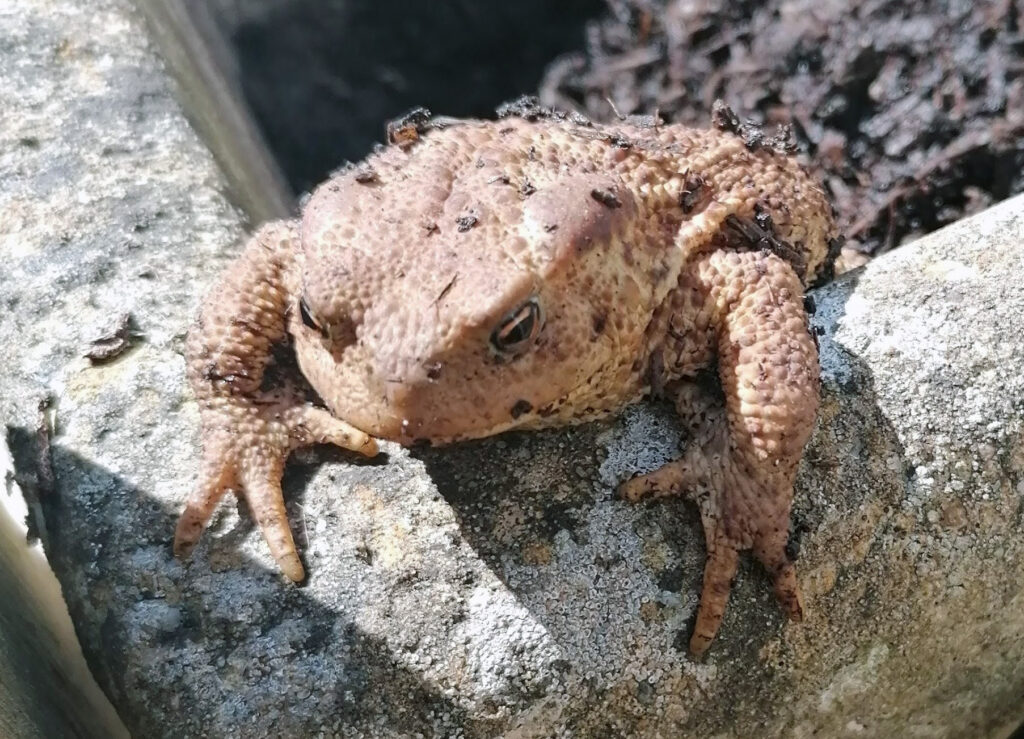
Bufo bufo the common English toad. Photo taken by Sally Murray in her garden near Ashill
Did you know?
- There are no toads in Ireland.
- Toads, like other amphibians and reptiles, evolved before warm-blooded animals. They cannot control their body temperature internally but rely on the right external conditions. Reptiles absorb the sun’s rays to warm up so they can hunt their prey. Amphibians such as toads, newts and frogs have soft skin that is water permeable. They need cooler, damper conditions, such as in leaf litter, under an old log or, as our photographer found, in the contents of a plant pot.
- Common toads are equally comfortable in the water and on land. On land, they breathe through simple lungs, but under water they can also take in oxygen through their skin. This makes them very sensitive to toxins in the water. Their presence in your pond is a good sign of the water quality there.
- Unlike frogs, whose spawn clumps together in the water, toad spawn takes the form of strings up to 7 metres in length, containing over 4000 eggs in jelly. After about 14 days tadpoles emerge from the jelly, these with a shorter tail and bulkier head than frog tadpoles. Development in the pond lasts around 85 days and once the tadpoles have absorbed their tails, they leave the pond, usually after a period of rain.
- On land, they are nocturnal hunters and have a huge appetite. As the gardener’s friend, they consume slugs, ants, snails, aphids, caterpillars, woodlice and other insects and even small mice.
- Although toads are generally solitary creatures, during the breeding season between mid-February and April large numbers congregate to migrate back to their ancestral breeding ground, to breed again. Because for many this entails crossing roads, it is estimated that over 20 tonnes of toads are killed on the roads each year. Some villages where the amphibians are known to cross organise ‘toad patrols’ who are out from dusk into the night with torches and buckets to take them across safely. The male toads tend to arrive at the breeding pond first. Arriving females can be swamped by the males, who try to ride ‘piggy back’ into the pond, creating a ‘toad ball’. Although the female toads can grow larger than the males (13 cm. v up to 8 cm.), some are drowned in the mating process.
- Around October time, the toads will seek shelter for the winter under dead logs, in compost heaps and in dry banks. They don’t hibernate but may emerge to forage on warm days throughout the winter.
- As you can see in the photograph, this brownish toad has the typical dark patch behind the eyes with their oval, horizontal pupil and golden iris. Whether the toad gave the typical high-pitched qwark-qwark-qwark has not been disclosed.
- The common toads can be tamed and become very friendly. Feed them regularly with mealworms and you may be able to get them to come when you call. But, on the other hand, you may find it more difficult to contemplate the toad as a household pet. Their bumpy, warty skin contains glands that secrete a white milky toxin when the toad feels threatened. This is not poisonous to humans: its main function is to make the toads inedible as the toxin is foul tasting. Their main predators are hedgehogs, rats, corvids, stoats and weasels. On occasion the skin of a toad has been found where a larger predator, such as an otter, has cunningly skinned its prey before consuming the toad.
- In the wild, common toads have a life span of 10-12 years, while in suitable habitats in captivity they can live much longer, reaching 40-50 years. However, today toads are seen to be in sharp decline, the main threats to their survival the spread of road traffic through the countryside and the reduction in ponds as a feature of land management.
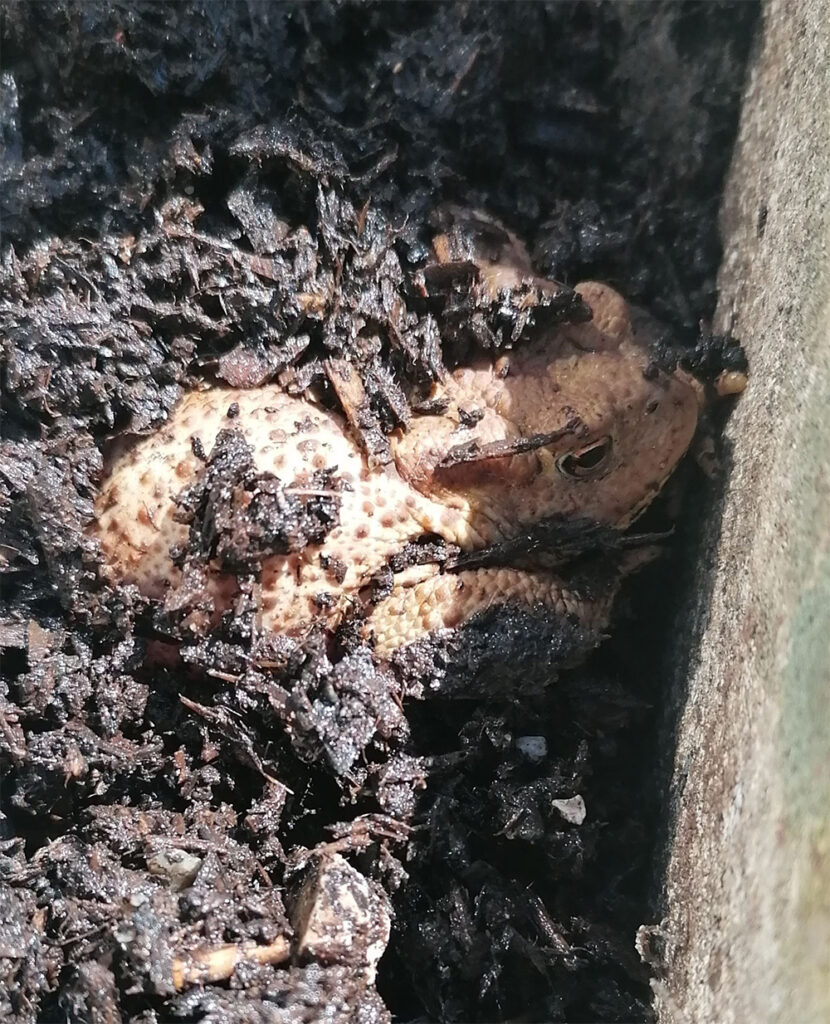
The English Common Toad. Photo taken by Sally Murray in her garden near Ashill
In 2008 the Million Ponds Project, involving 60 organisations, set about creating a network of new ponds for rare and declining species of amphibians and invertebrates. Their aim is to make pond creation and management routine within land management, with at least 1,000,000 ponds across the UK, approximately the same number of ponds that could be seen in 1900. The first phase of this 50-year project ran from 2008 to 2012 and resulted in the creation of over 1000 ponds across England and Wales.
For more information on this pond creation and conservation project, you can find it on the Freshwater Habitats Trust website and the Amphibian and Reptile Conservation Trust website . Alternatively, you can follow the link: about-the-million-ponds project.pdf
Information for this article was taken from the websites of the Freshwater Habitats Trust and the Amphibian and Reptile Conservation Trust as well as