
This beautiful photograph, taken by Ann Waller on West Furlong in Bishopsteignton, tells us much about the feeding habits and the sociability of this bird. The goldfinch is one of the most common garden birds in the UK; in fact, the goldfinches’ fondness for niger and sunflower seeds in garden bird feeders is seen as one of the reasons for their strong increase in population since 1995: monitoring between 1995 and 2023 showed an increase of 152%.
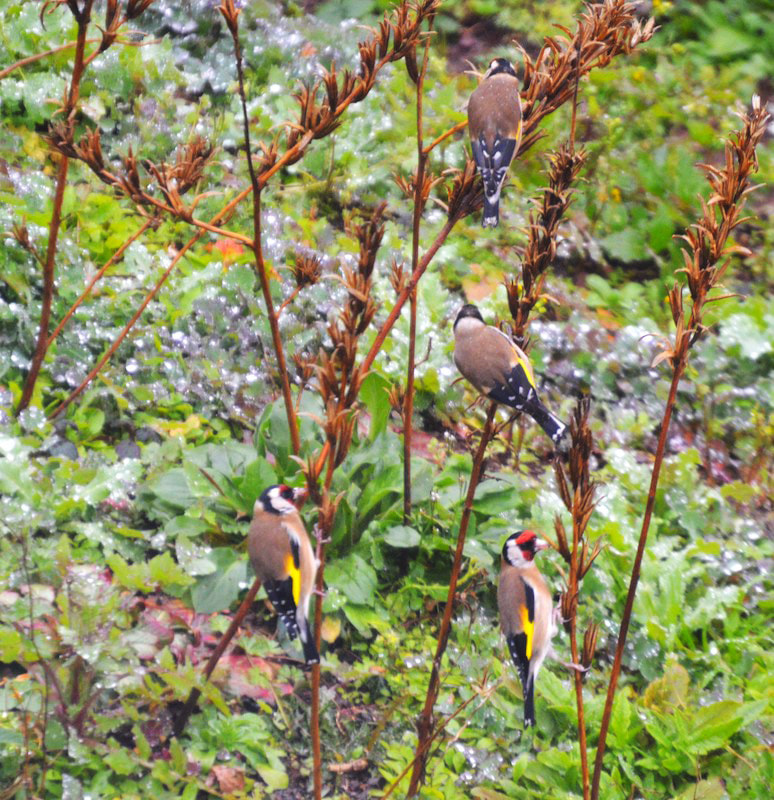
Goldfinch eating seeds, West Furlong Bishopsteignton
In earlier decades, specifically in the 1970s to the mid-1980s, there was a dramatic decrease in the number of goldfinches, caused in part by the widespread use of herbicides. Today it is estimated that there are 1.7 million pairs of goldfinches breeding in the UK.
Back to the photograph: we can see that these birds are enjoying a diet of seeds. Their fine strong beaks enable the goldfinches, unlike other songbirds, to take the seeds from teasels and thistles; they also feed on the small seeds of dandelions and ragwort. The Anglo-Saxons called goldfinches ‘thistle-tweakers’. In fact, the goldfinch’s Latin name ‘Carduelis carduelis’ is derived from the Latin word for thistle, ‘carduus’. ‘Redcap’ has also been a name used for this bird, as in the poem by John Clare (1793-1864), ‘The Redcap’:
The redcap is a painted bird
And beautiful its feathers are;
In early spring its voice is heard
While searching thistles brown and bare…
We can see as well in Ann’s photograph evidence of the sociability of the goldfinches, which sometimes fly during the winter in flocks of up to 100 birds. The term for a group of goldfinches originated in the old English word ‘c’irm’, meaning twittering or chattering. They are now referred to as a ‘charm’ of goldfinches, this sometimes belied by their behaviour as they can seem quite ‘grumpy’ in their territorial behaviour towards other birds (‘A Charm of Goldfinches?’ https://uknaturegifts.com).
Goldfinches are slightly smaller than robins. They are easily recognisable with their bright red face and black and white head, the males and females differing with the extent of the red mask being greater amongst males than females. They all have a yellow patch on their dark wings and a greyish, creamy-coloured underside. Juveniles have a streaky brown body and head with the characteristic yellow patch on their black wings. They don’t show the full bright markings until after their first moult.
These birds live in woodland, orchards, gardens and fields with plenty of wild plants. They tend to breed later than other birds, possibly waiting for the availability of seeds. In preparation for mating, the female will build a cup-shaped nest of roots, lichen, grass and moss, lined with hair and wool. This will be well off the ground, at least two metres, and in dense vegetation. Females tend to lay between 4-6 eggs and may sometimes nest two or three times a year. The eggs are incubated for nearly a fortnight, both parents bringing food to the nest. With plenty of food and care the young birds are ready to fledge the nest after only around another fortnight, a shorter period than most juveniles. The male goldfinch will continue to feed the young birds even after they have left the nest. The parents retain a monogamous relationship for one season, with a new mate found the following year. The lifespan of a goldfinch is usually around two years.
Historically, these birds have been sought after for their beautiful song. This was particularly true in the Victorian period, when the popularity of trapping and then caging the goldfinches resulted in a sharp decline in the wild population in this country. Many of the caged birds were subject to further cruelty, in being blinded with a hot needle; this done in the belief that the blinded birds’ song would be continuous as they were free from distraction. Thomas Hardy’s poem, ‘The Blinded Bird’, laments this practice:
So zestfully canst thou sing?
And all this indignity,
With God’s consent, on thee!
Blinded ere yet a-wing
By the red-hot needle thou,
I stand and wonder how
So zestfully thou canst sing!
The practice was outlawed with the passage of the Wild Birds Protection Acts in the late 19th and early 20th century.
The goldfinches’ beautiful colouring has also made them the subject of special attention in European folklore. Their yellow plumage has been associated with joy, prosperity and renewal. In the early 18th century a colloquial term for a wealthy person was ‘goldfinch’, and gold coins were sometimes called ‘goldfinches’. The bird was even thought to protect against illness, and became a symbol of protection against the plague in the 14th century. This was possibly connected to their diet of thistle seeds, these thought to combat the plague; and also their golden plumage, which was associated with health and renewal (https://fitzmuseum.cam.ac.uk). But it is the bird’s bright red face that really brought it into prominence in legend and expressions of spirituality.
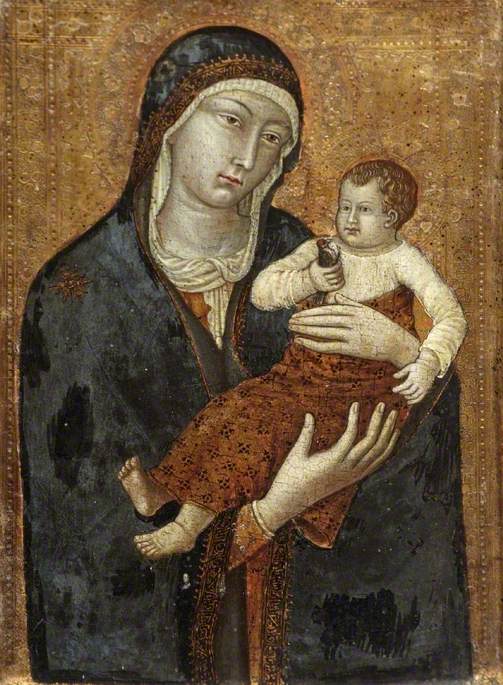
Madonna and Child with a Goldfinch. Credit: Russell-Cotes Art Gallery & Museum, Bournemouth
The story goes that the bird’s red mask was a mark of the goldfinch’s flight to Christ carrying the cross. As it attempted to draw out a thorn from the crown around his head, easing Christ’s pain, a drop of blood splashed on the bird’s face. The goldfinch’s role in sacrifice and redemption made it a regular symbol in pre-Renaissance and Renaissance art, with the bird featured in hundreds of paintings, such as Giotto’s Holy Bishop with a Goldfinch, Raphael’s Madonna and Child with a Goldfinch, Leonardo da Vinci’s Madonna Litta and paintings by Botticelli. Often the bird is in the hands of the baby Jesus, representing the soul, sacrifice and resurrection. Michelangelo’s Madonna and Child with the Young St John (a marble relief completed in 1502) shows the infant Jesus looking almost alarmed as he draws back from a fluttering goldfinch in the hand of St John (Friedmann 1946).
Alongside the hundreds of devotional paintings featuring the goldfinch is probably the most famous depiction of the bird. This is in the life size painting, The Goldfinch (1654) by Carel Fabritius, a student of Rembrandt, dated 1654. Here the subject is the goldfinch as goldfinch.
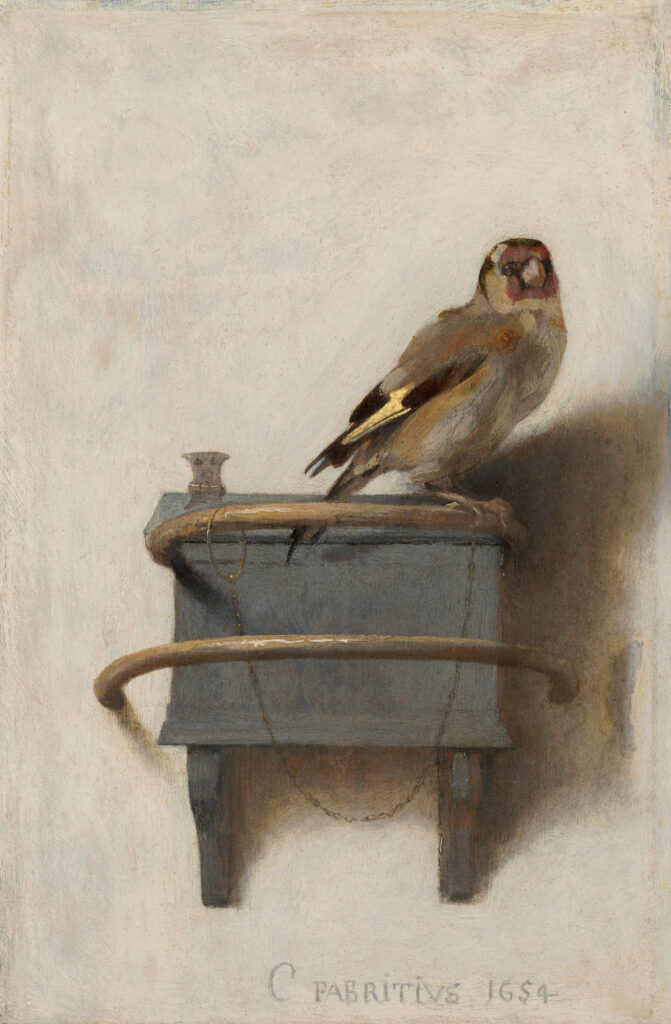
The Goldfinch by Carel Fabritius. Credit Mauritshuis, The Hague.
References
The Goldfinch in Renaissance Art https://datazone.birdlife.org
The Goldfinch https://fitzmuseum.cam.ac.uk
Goldfinch Bird Facts https://rspb.org.uk
Goldfinch (Carduelis carduelis)—British Birds https://woodlandtrust.org.uk
A Shot of Wildlife—YouTube
Cocker, M. and Mabey, R. (2005) Birds Brittanica. London: Chatto and Windus. Pp. 448-51.
Friedmann, H. (1946) The symbolic goldfinch: its history and significance in European devotional art. Washington D.C.: Pantheon Books.