
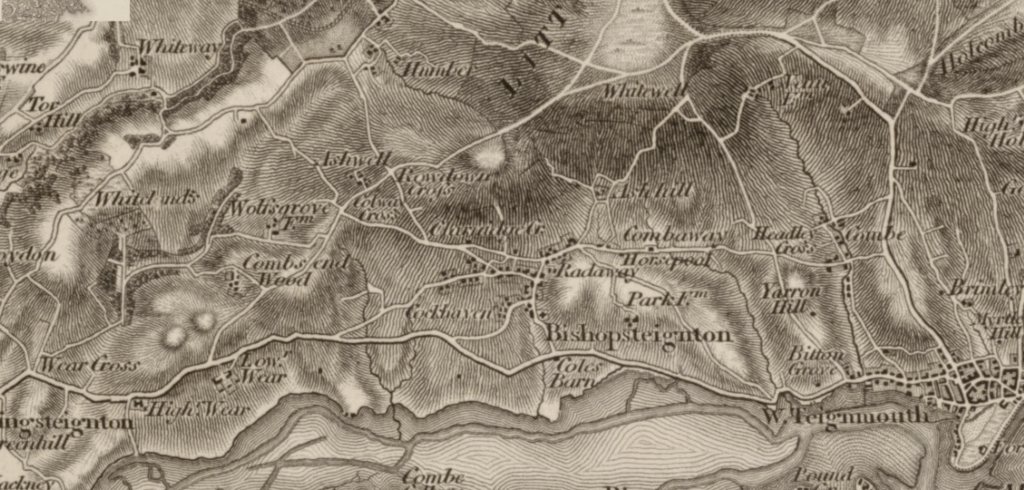
1809 Map of Bishopsteignton showing Wolfsgrove Farm
At the heart of this story is my fourth great-grandfather, James Cornish, born in 1790.
In 1810, he married a Mary Grills, who had come from Modbury, and together they built part of their life at Wolfsgrove Farm. Over the years, they raised a large family of seven children: George Henry (1813), James William (1817), Anna (1820), James (1821), Mary (1824), Emma (1829), and Sarah (1831). Their household would have no doubt been lively and busy, filled with the demands of both family life and the constant work required to maintain a working farm.
By 1841, James and Mary were firmly established at Wolfsgrove, where daily life would have revolved around the land. Farming in this period would have required relentless effort. With no machinery to ease the burden, the family and their labourers would have had to rely on physical strength, skill, and routine. The farm would have included fields for crops, pasture for livestock, and outbuildings for storage and shelter. Each day beginning early, with animals to feed and tend before work in the fields could begin.
The size of the farm and the number of labourers employed in later years suggest that Wolfsgrove was a significant agricultural holding. Their son, James William Cornish, would go on to farm 350 acres there in 1851, employing 11 labourers. This scale of operation reflects both the success of the family and their important place within the local farming community. Such a farm would have required careful management, coordination, and a deep understanding of the land.
Despite the strength of their family and livelihood, James and Mary’s later years were to be marked by loss. Mary died at Wolfsgrove Farm on 20th July 1852 at the age of 64. Five years later, on 29th October 1857, James also passed away after a prolonged illness, aged 67. Both were laid to rest at St John’s Church in Bishopsteignton, returning finally to the parish that had framed so much of their lives.
Their children carried forward the family’s farming legacy, spreading across the surrounding area. George Henry Cornish, born in 1813, married an Ann Adams and farmed at Venn Farm in Teignmouth, managing 200 acres with three labourers. Later, they moved to Higher Rixdale in Luton, where they farmed 104 acres with a smaller workforce.
Interestingly, records suggest that George had once been listed as an army deserter in 1836—perhaps an indication that his true calling lay not in military life, but in the fields and farms he would later manage. George lived a long life, passing away in 1902, and was buried alongside his wife in Luton Cemetery.
Another of James and Mary’s children, Anna Cornish, married a James Vooght in 1815. Together they farmed Laws Farm in Luton, working 140 acres and employing four labourers and three boys. Their farm, like others in the family, reflects a pattern of steady agricultural enterprise. When James Vooght died on 26th March 1886, he left a personal estate valued at £557 1s. 4d., a sum that at the time would have suggested a degree of financial stability and success.
James William Cornish, born in 1817, remained closely tied to Wolfsgrove Farm, continuing the family’s work there for many years. By 1851, he was managing the substantial 350-acre holding with a sizeable workforce. Later in life, he retired to Kingsbridge, living at Miller Court on Fore Street before passing away at Myrtle Cottage on 15th July 1900 at the remarkable age of 93. His long life spanned a period of great change, from the early 19th century into the dawn of a more modern age.
The wider Cornish family also played a role in maintaining the agricultural presence in the area. James’s brother, Richard Cornish (1795–1866), married a Mary Wills in 1826 in Kingsteignton. They farmed Lower Rixdale Farm in Luton, and their son Thomas Cornish continued the family tradition by farming Wolfsgrove in 1881 with his wife Susan. This continuity of land and labour across generations highlighted a deep connection the family had to the area and its farming heritage. Life for the Cornish family would not have been easy. Farming in the 1800s meant constant exposure to uncertainty—weather, illness, and fluctuating markets all posing challenge. Yet, through these difficulties, the family endured and, in many cases, thrived. Their ability to manage large farms, employ labourers, and pass on their work to the next generation speaks to their resilience and determination.
Today, as I live in Bovey Tracey, close to where my ancestors once worked the land, their story feels both distant and immediate. The fields they farmed, the villages they lived in, and the churches where they are buried remain part of the same landscape. Their lives, rooted in hard work and family, have left a lasting imprint—not only on the land itself but on the generations that followed of which I feel so proud to be part of.
In remembering James and Mary Cornish and their descendants, I am gently reminded that history is not only found in grand events, but in the steady, everyday lives of those who came before us. Their legacy lives on in the fields they once tended and in the family they helped to build, a quiet but enduring testament to a life lived close to the land.
I’m currently still researching the Cornish side of my family, which from information I’ve so far gathered extends a strong connection close to me in the Parish of Ilsington.
Foot note: James, Colin and the rest of the team at Bishopsteignton Heritage have been amazing in helping me find my heritage connections, hence I feel obliged to make a small contribution to the Bishopsteignton archives.