
As the Bishop’s Estate grew throughout the 13th-Century in the legacy of the Saxon receptor of the Bishopric in 1050, Leofric, Bishops’, or the Latin equivalent ‘Episcopi’, was added to form ‘Bishop’s Teynton’. This linguistic development towards ‘Teynton’ denotes the village’s status as a settlement along the estuary, becoming increasingly consolidated through a plethora of bishops, events and changes throughout the medieval period, both nationally and within the local area, all of which impacted village life in Bishopsteignton.
In terms of population, the village was small, growing from 300 - 400 people at the time of the Domesday survey to around 500 people in 1600. The settlement was focused around the church and manor lands. Yet the village was nonetheless significant throughout the Middle Ages and into the Early Modern period with its links to Exeter through the Bishop and along the estuary.
In Early Medieval times, the parish formed part of the Exminster Hundred, with nearby salterns and estuary trade shaping local life which broadly continued into the later Middle Ages and Early Modern Period. The hundred combined Dawlish, Kenn and Exminster, in the Exe Valley, with Bishopsteignton in the Teign Valley. It is likely that this was due to Bishopsteignton being the centre for ecclesiastical estate, with Kingsteignton, in the Teignton Hundred, was governmental.
Thus, Bishopsteignton developed between 1200-1600 in the legacy of Saxon influence, expanding as a bishopric and settlement with ecclesiastical importance with links to Teignmouth and villagers and their lives were undoubtedly impacted by various events throughout these centuries.
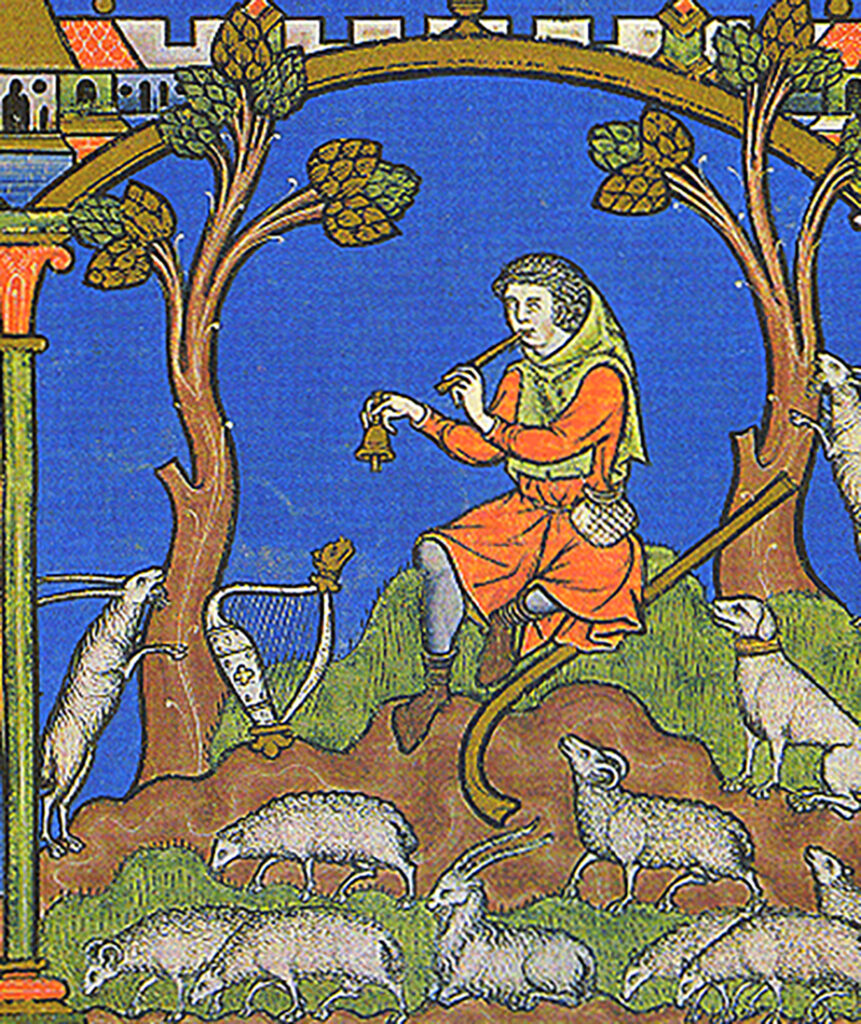
This image shows a farmer playing pipe and bell as he watched his sheep, c. 1250. Farming, agriculture and harvest was a large part of rural English medieval life in villages.
Village life in Bishopsteignton from 1200-1600 was largely typical of many rural villages in England at the time. Prominent village features included St. John the Baptist’s Church, alongside ecclesiastical housing, such as the vicarage and the Bishop’s Estate, as well as a village green for markets and community events.
Early houses were simple one-room buildings, with farm houses developing in 1200 into single-roomed rectangular buildings, as excavated at Hound Tor. By 1600 more permanent stone houses with upper floors appeared, and it is probable Ashill farm originated in this development as a Devonshire Long House around 1400, of cob and clay with a thatched roof, and throughout the Whitbourne family’s continuous almost 200-year occupancy, they added the first floor, partitioned rooms and added staircases.
By 1610, the manors in the area (Bishopsteignton, Lyndridge, Radway and West Teignmouth) consisted of 100 large houses and gardens, 20 cottages, 100 barns, 100 gardens, 200 acres of land, 100 orchards, 2000 acres of meadow, 1000 acres of pasture, 100 acres of wood, 1000 acres of furse and heath as well as the fishery in the River Teign, totalling some 5100 acres, used as housing and farmland.
The period of 1200-1600 shows the shift from wattle and daub housing to the sturdier brick, as well as the rise in records of established families. Hence upon Bishop Vesey handing the prominent manors to Edward VI, there was already a ready market for land developed, and upon the Bishop’s death it is speculated that the Earls of Salisbury were the next owners, having bought it from the king.
In wider society, the 1597 Poor Law expanded support beyond the “deserving poor” (elderly, widows, disabled) to the unemployed, providing a development in community support within the nation.
The triangle formed by Clanage Street, West Street and Fore street is often said to be where the former village green was, with buildings such as church houses, poor houses or alms providing insight into the medieval layout of the village. A charter of 1256 renewed by Henry III in 1270, granted the Bishop a Thursday market and a 3 day fair over the feast of St James in 'Teynton’, providing insight into community life.
The population was stable and small, with about 115 family names recorded 1560–1600, with the emergence of key families such as Babbe and Cove appearing more frequently in parish records and wills from 1558.