
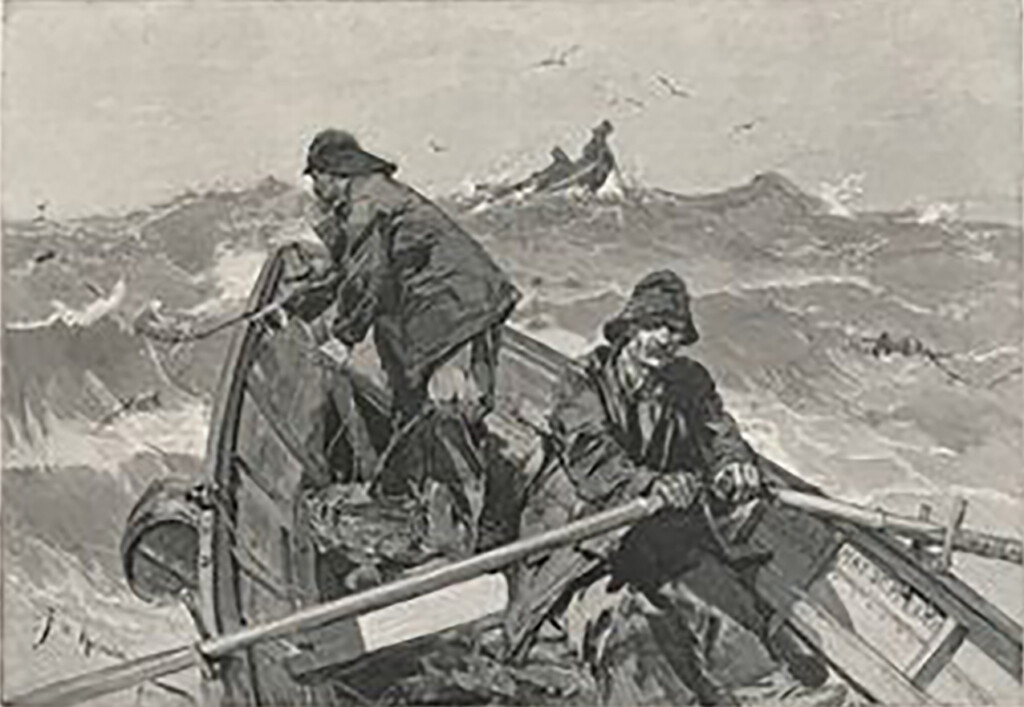
Newfoundland cod fishing boat source Wikipedia
Ships, Cargo and Voyages
John Hore captained the Abeona for seven years and on the voyage in 1834 was accompanied by his younger brother Robert, described as a mariner. The Devon Shipping Records for the Ports of Teignmouth and Exeter hold these details of the ship:
- Abeona ofTeignmouth 22, sailing vessel, square rigged, built at Richmond Bay, Prince Edward Island in 1821. Formerly registered at Exeter 4/1822. Vessel registered anew and registry cancelled 18th November 1836. Title owned by Matthew Warren.
- Abeona 83, sailing vessel, brigantine, built at Richmond Bay, Prince Edward Island in 1821. Vessel transferred to Teignmouth and registry closed 29th October 1853. Title owned by Matthew Warren, William John Watts, Samuel Whiteway, Charles Kilson.
The North Atlantic trade was very lucrative for ship owners such as Matthew Warren with cargoes of salt, cod, fruit and oil being shipped seasonally. In addition, the availability of suitable timber, native North American pine or oak, in Prince Edward Island and Newfoundland meant it was economically beneficial to have their ships custom-built there and then registered at the home ports of Exeter and Teignmouth.
Prince Edward Island was, at that time, a British Colony and is now one of the three Maritime Provinces of Canada.
A few years later, during the 1840s, John is Master of the schooner Haberdine which was again owned by Matthew Warren. Mentioned in the book 'Teignmouth' by H.J. Trump, a Maritime Historian, is a reference to the Haberdine, detailing a typical consignment of goods carried by the schooner to Newfoundland:
- "A record of Teignmouth exports and imports to and from Newfoundland is not available before 1853 but the following consignments, shipped by Matthew Warren on the schooner Haberdine in April 1854, may be taken as typical for this earlier period:
- 8 bags of nails, 12 cwt. iron, 1 crate earthenware, 5 wheelbarrows, 14 casks of tar, 12 cwt. leather, 30 'feet' apparel, 3 tons twine and net, 16 hampers plants.
- The Memorandum Book of John Rendell of Aller (Newton Abbot) shows that at least one hogshead of cider was also shipped on this voyage although it does not appear in the port records since it was presumably for the consumption of the crew."
At that time, St. John’s in Newfoundland was a settlement which was expanding due to the thriving fishing trade, especially in the area known as Grand Banks, where there was an abundance of cod. Settlers would need items for building and repairing, for households and businesses, all goods which needed to be imported. The voyages were timed for the fishing season and on each stage of the journey the ships would be loaded with the relevant cargo to ensure maximum profit.
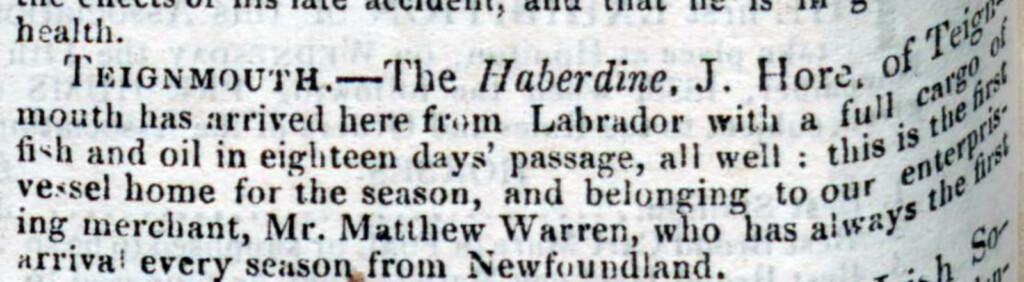
Captain John Hore (1806 – 1882) returning to Teignmouth from Labrador on Haberdine 1838.
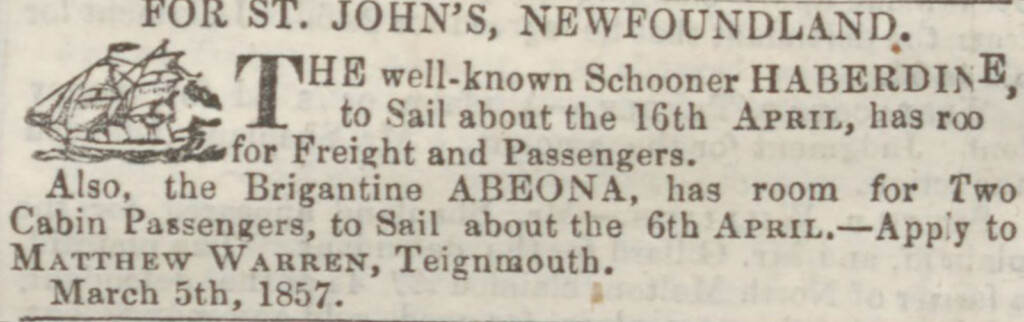
Advertisement for freight and passengers for St. John’s in Newfoundland on Haberdine and Abeona 1857
The origin of the name Haberdine translates roughly from the Dutch as Salted Cod and the details held in the Shipping Registers are as follows:
- Haberdine 6, sailing vessel, schooner, built at St John’s, Nova Scotia in 1830. Vessel registered anew at Exeter (no.9) and registry cancelled 12th April 1838. Title owned by Andrew Howard, Matthew Warren.
- Haberdine, 9, schooner, built at St John’s, Newfoundland in 1830, title owned by Matthew Warren.
Newfoundland was also a British Colony, and is a large island, now within the Canadian province of Newfoundland and Labrador with St. John’s as its Capital.
Captain John Hore's voyages continued, although we find him in the 1851 Census living in Bishopsteignton at Mount Radford, near the top of Smith Hill. He sailed for a further six years, leaving the Service with a pension in 1857.
For those final years of sailing, John is Master Mariner of the Nancy, built in Topsham and owned by the Ward family. The ship is a brigantine, a two-masted vessel with a square-rigged foremast, a fore-and-aft rigged mainmast and a tonnage of 130 tons. He continues to ply his trade for cod with Newfoundland and Labrador alongside the coasting trade around the British Isles, delivering and collecting clay, stone and coal.
Shipwreck
The final voyage of the Haberdine came in March 1857. Bound for St. John's in Newfoundland once again, the agent Matthew Warren was advertising for freight and passengers, planning to sail in mid-April. However, for some reason, she sailed early. A local newspaper, the West Briton and Cornwall Advertiser, dated 27 March 1857, reported that:
"the schooner Haberdine of Teignmouth ran for the harbour of Padstow in a heavy gale of wind and most tremendous sea...the lifeboat, manned by volunteers was gallantly rowed through a heavy sea alongside the drifting ship, and the crew, four in number, were taken out and brought safely on shore. The Haberdine was driven on to the rocks off Tristram and knocked to atoms."
It was the first mission for the Padstow lifeboat in "assisting vessels in distress", being funded by local subscriptions and placed in Padstow by the Royal National Lifeboat Institution, known to us today as the RNLI.
Family Life and a Career Change
After John married Elizabeth Fulford in 1837, they had four children, all born in Bishopsteignton. Although the address is unclear, we find Elizabeth in the 1841 census when she is 25 years old, living in Bishopsteignton with her son John Henry, aged 2 years, and her elder married sister Mary Rowe. Two more sons followed: William Thomas Fulford Hore, born in 1845, and Frederick Fulford Hore, born in 1847. Later, in 1854, daughter Sarah Elizabeth Fulford Hore was born; sadly she died when only 19 years of age.
John purchased Fulford Cottages, Clanage Street from the "Guardians of Newton Abbot and others" in 1849.
As mentioned above, in the 1851 Census John is 44 years old and living with wife Elizabeth, aged 37, at Mount Radford, Smith Hill. He is described as a Ship's Master and she is a Dressmaker. Sons John Henry, William Thomas and Frederick are now aged 11, 5 and 3 respectively.
By the next Census, ten years later in 1861, things have changed. John has come ashore and is a Grocer living in Fore Street, presumably at the Village Shop, and Elizabeth is a Grocer's wife. Eldest son John Henry is working with his father as a Grocer too. William Thomas, Frederick and their sister Sarah Elizabeth are all attending school. John was also pursuing other interests by investing in property in the village. In 1859 he built Teign Villas, “a pair of imposing semi-detached houses", having obtained a 99-year lease for the site on Fore Street from the Reverend George Thomas Comyns in 1859.
In 1871 the family have moved to Teign Villas. John has retired and John Henry is no longer living with them, but William Thomas is following in his brother's footsteps and at the age of 25 is working as a Grocer's Assistant. By 1881 John and Elizabeth are in Dawlish where other family members are living and working but a year later John dies.
Captain John Hore was buried in Bishopsteignton on the 22nd of November 1882, and the Probate of his Will was read on 13th January 1883. The 'Fulford Cottages' were inherited by his wife Elizabeth Fulford Hore.
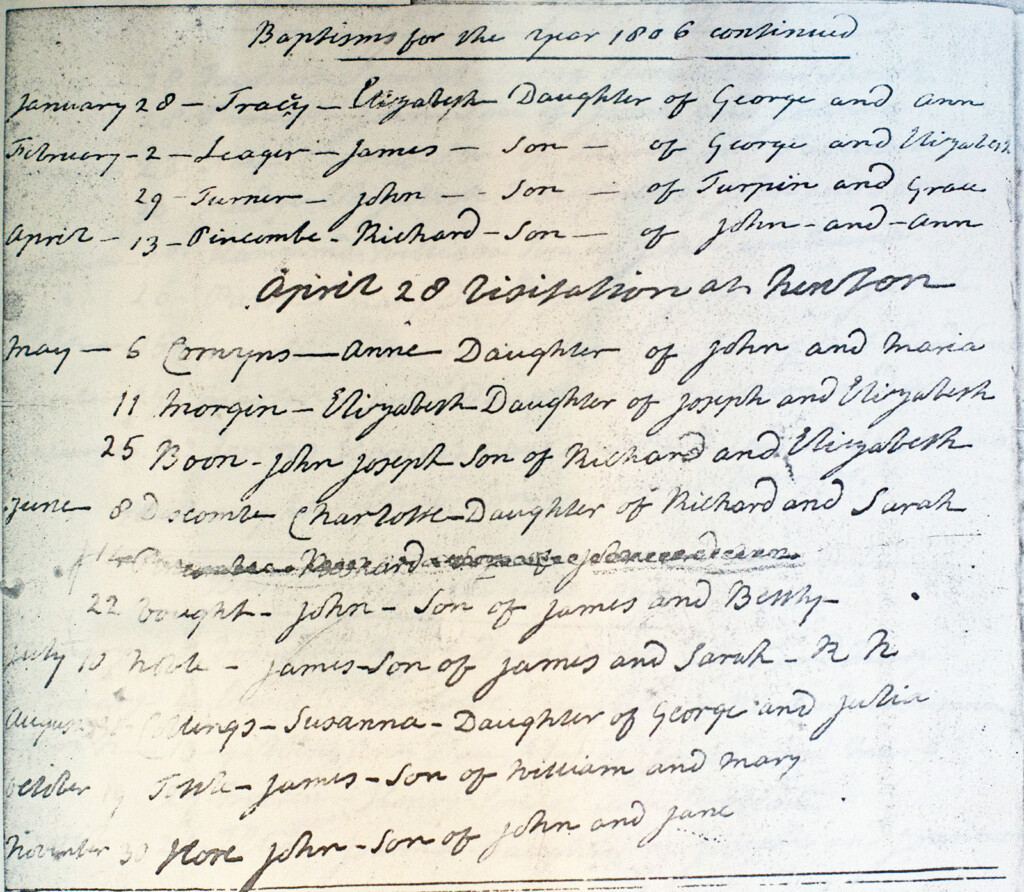
Baptism record from Parish Registers 1806
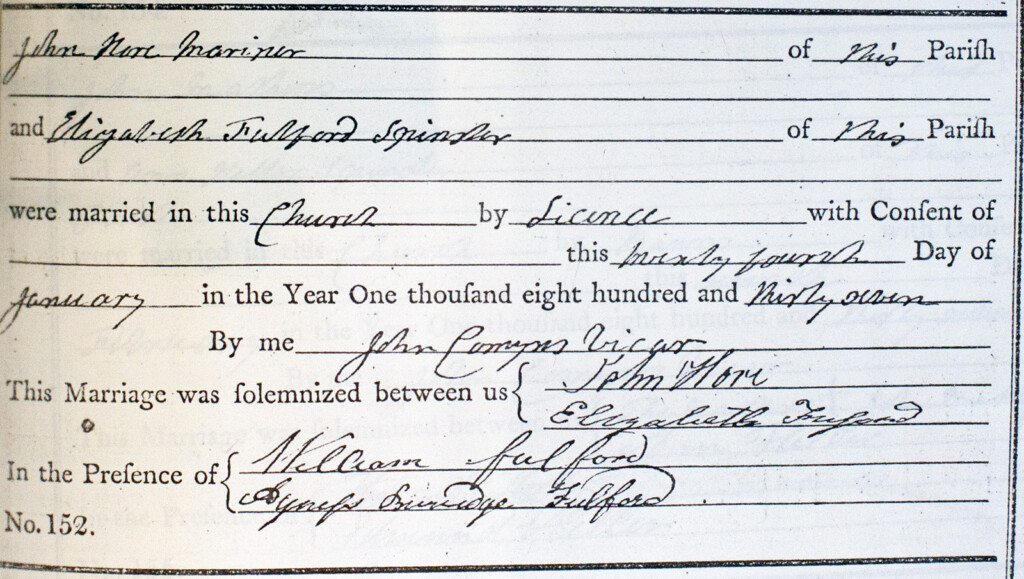
Marriage Record for John Hore and Elizabeth Fulford from Parish Registers 1837
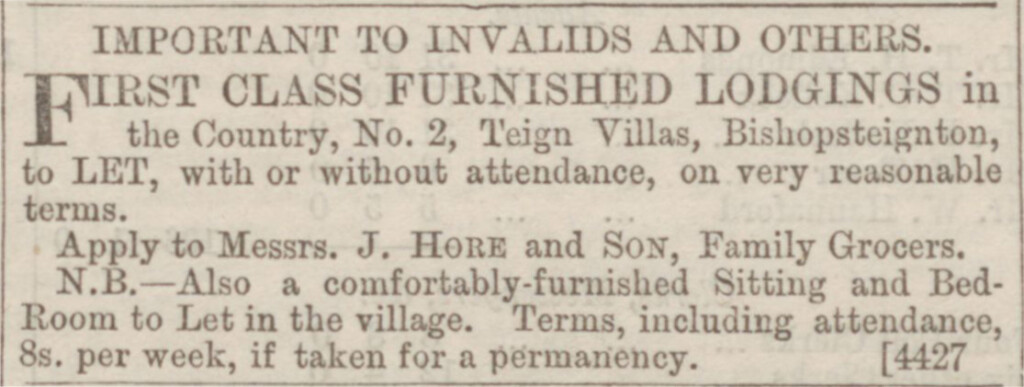
Newspaper cutting for Teign Villas and reference to family grocers 1863
The Family Legacy
A file of documents belonging to the Hore family was donated to the Devon Heritage Centre in Exeter by Captain John Hore’s grandson, Henry Samuel Bennett Hore, who became a councillor and alderman of Torquay and was awarded an M.B.E. Titled the “Hore Family Collection, 1854 -1964” it comprises "Papers, ancestors, family and career of H.S.B. Hore."
As for our Captain John Hore, part of his gravestone can be found here in Bishopsteignton Parish Churchyard where he was buried in 1882 aged 76 years.
However, as part of the search we had a surprise. In the older part of the Churchyard was another grave with the name John Hore. Quite by chance we had discovered the seafaring father of our John. Also a Mariner by trade, it tells us some of his story and that of his family.
Although very weathered, this is what we found:
Sacred in the memory of John Hore of this Parish
died in Newfoundland
the 1st of June 1828 aged 50.
Also of Sarah his daughter
who died 31st August 1831 aged 11 years.
Also Jane wife of the above
died 6th November 1860 aged 80 years.
Also in memory of
Joseph, Thomas, Robert,
William Hore. Four of their sons
who perished at sea.
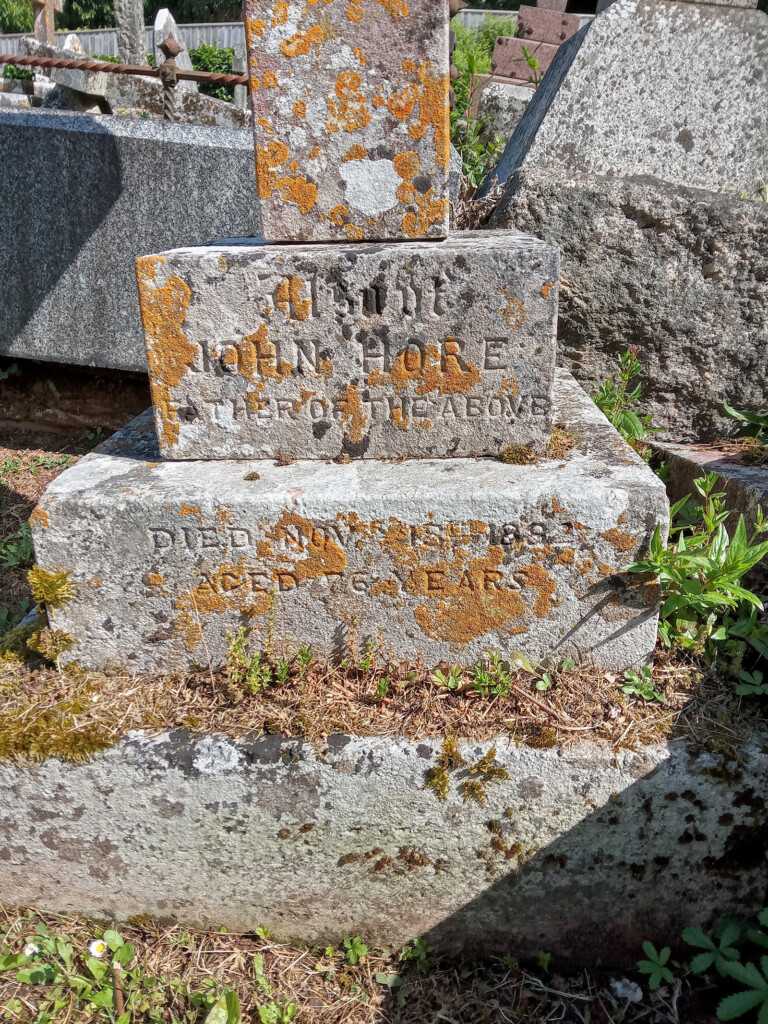
Gravestone of Captain John Hore (1806 - 1882)
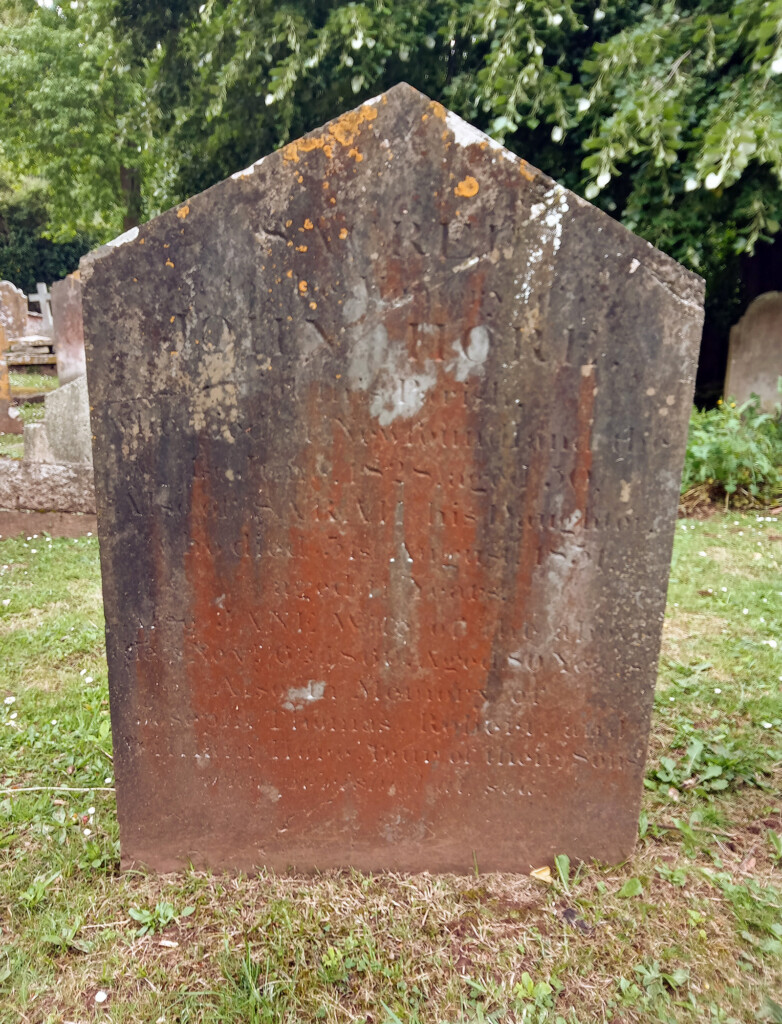
Gravestone of Mariner John Hore (1778 - 1828)
With special thanks to Barbara Sealey for her extensive research into the Newfoundland maritime history and the connections with Teignmouth and Bishopsteignton.