
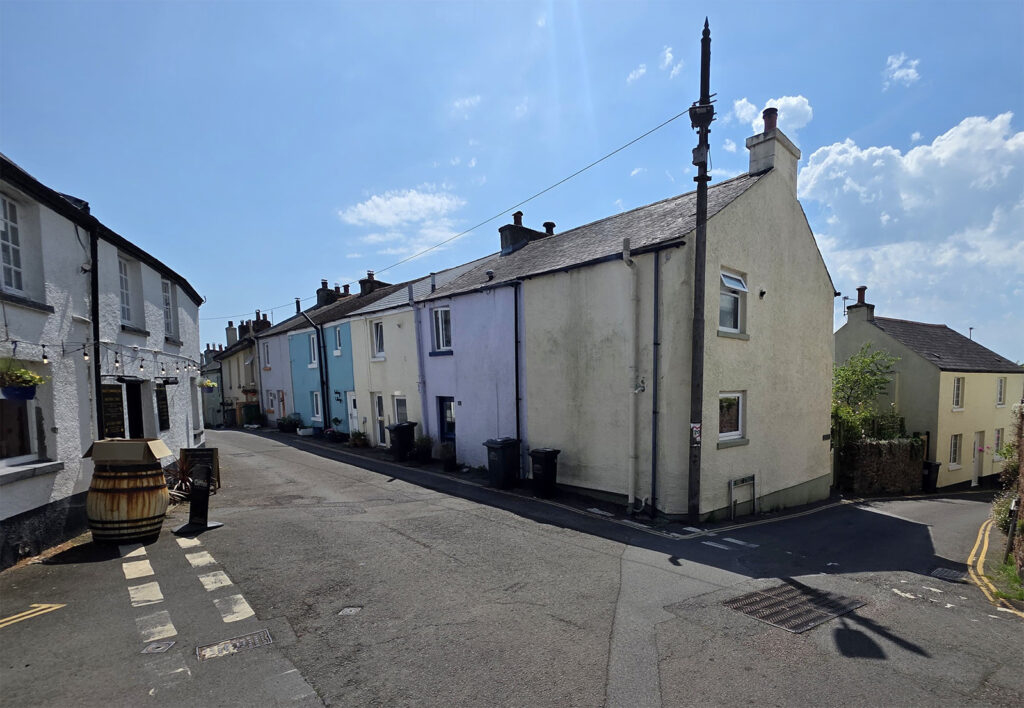
Fulfords cottages and Old Commercial 2026
Origins
The Poor Houses of Bishopsteignton were situated here and are shown on the Tithe Map published in 1840. The Land Owners were the "Bishopsteignton Feoffees of the Poor" and the Occupiers were "Andrew Holman and others". The cottages and their occupants were overseen by the Newton Abbot Union and were also referred to as the four Pauper's Cottages. At that time they were thatched, as described in the Fire Insurance policy of 1830 held at the Devon Heritage Centre. The Census of 1841 tells us that Andrew Holman was 40 years old and worked as an Agricultural Labourer. Living with him was Maria Holman, aged 35, their son Andrew who was 1 year old, and William Weeks, a scholar, aged 12.
Subsequently, due to the Poor Law Amendment Act 1834 during the reign of William IV, the Overseers of the Poor were able to sell the properties, that is, " the four freehold tenements in the occupation of paupers - John Martin, Andrew Holman, William Dinsham and Mary Commins". The prospective buyer for the houses in 1845 was a William Hammond. Unfortunately he became unwell, being described as a "pauper lunatic", and the sale had to be discontinued.
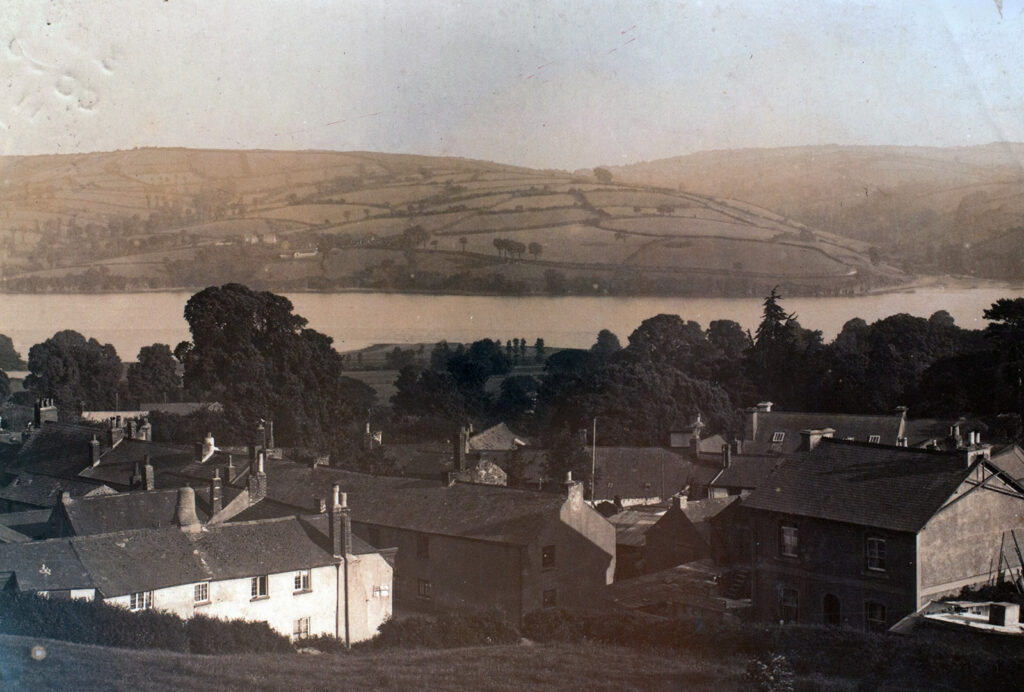
Roofline of Fulford Cottages c 1900
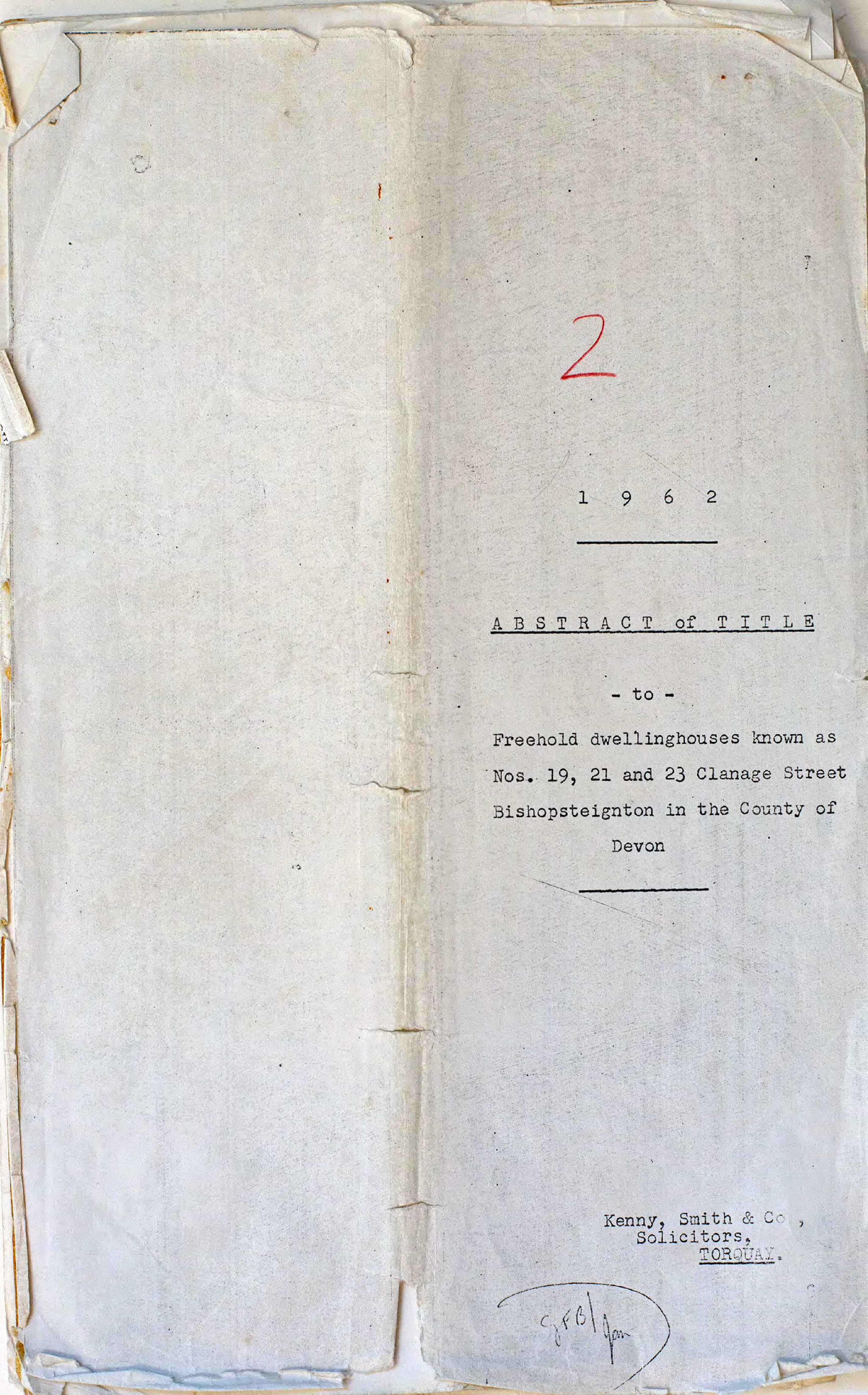
Title Deed 19 Clanage Street Bishopsteignton 1962
View full document here
Master Mariner Captain John Hore
The sale of the properties went ahead in 1849 to a more reliable purchaser, Captain John Hore. The Conveyance dated February 21st 1849 is between "The Guardians of the Newton Abbot Union and Others to Mr. J. Hore". It appears that during this time changes were made to convert the four cottages into five, presumably by dividing one cottage into two. Current residents think this may have been the house at the end of the terrace, on the corner of Clanage and West Street. John Hore also purchased the cottage around the corner, in West Street, known as Church Cottage or Chapel House and which is included as part of Fulford Cottages.
Read more about Captain John Hore, his family, seafaring career and connections to Newfoundland.
The Fulford Connection
Between voyages, John Hore married Elizabeth Fulford (born 1814) on 24th January 1837. She was a dressmaker from Kingsteignton and her parents were John Fulford and Mary Burridge Fulford. This is likely to be the same John Fulford that is mentioned on the Tithe Map of 1840 as being the Land Owner of the Commercial Inn in Bishopsteignton, with the Occupier and Inn Keeper being William Piles. John Fulford also owned a "homestead and garden" near the top of Shute Hill, where Cross House and the Community Centre are now, shown on the Tithe Map as plots 1251 and 1252.
What happened to the original Fulford Cottages?
The cottages stayed in the family until 1926. When Elizabeth Fulford Hore died in 1897, at the age of 83, she was living with her youngest son, Frederick Fulford Hore in Kent and Frederick was the Executor of her Will. He was a schoolmaster in the Royal Navy between 1861 and 1898. The cottages were gifted to Frederick by his mother. On Frederick's death they passed to his brother William Thomas Fulford Hore, who in turn left them to his wife Augusta Bennett Hore.
Finally the Fulford Cottages were inherited by William and Augusta's three sons, the grandchildren of Captain John Hore Master Mariner and named for his wife Elizabeth Fulford Hore.
Of the three grandsons, two followed the family seafaring tradition of their grandfather. In 1926 when the cottages were sold they were working as follows:
Henry Samuel Bennett Hore (born 1880) was a Schoolmaster in Torquay.
William John Bennett Hore (born 1875) was with HMS Excellent in Portsmouth, a Lieutenant in the Royal Navy.
Frederick Joseph Bennett Hore (born 1878) was based at Chatham in Kent, a Major in the Royal Marines.
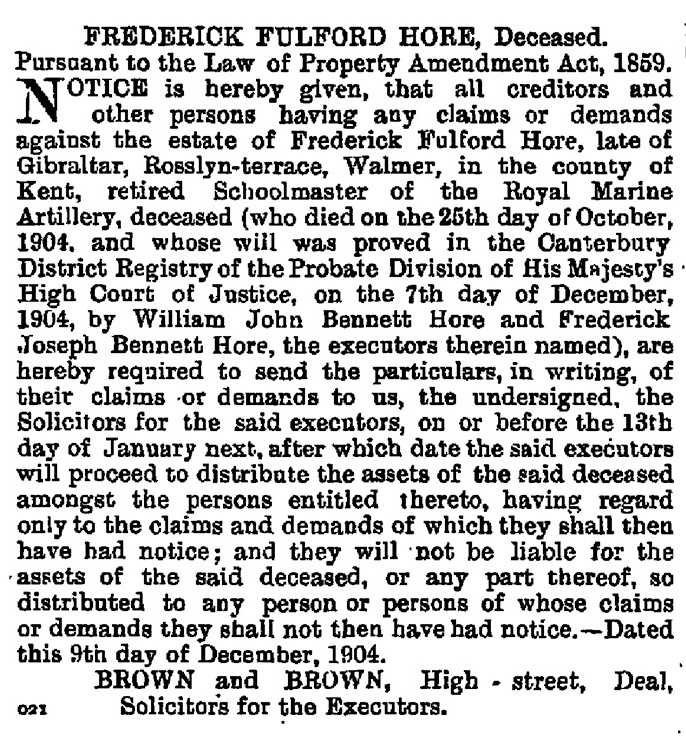
Probate of Frederick Fulford Hore 1904 as reported in the London Gazette
Where are the cottages now?
Numbers 1 and 6 were inherited by Henry Samuel Bennett Hore.
Numbers 2 and 3 were inherited by Frederick Joseph Bennett Hore.
Numbers 4 and 5 were inherited by William John Bennett Hore.
In 1926 the cottages were purchased by Herbert Jeffery, a retired farmer from Dawlish. The tenants at that time, and recorded in the 1921 census, were:
Herbert William Ridgeway and Florence Maud Ridgeway in Number 1 Fulford Cottages, now 17 Clanage Street.
William Henry Honeywill, Florence his wife, and their three sons in Number 2 Fulford Cottages, now 19 Clanage Street.
Charles and Susan Martin, their three daughters and one grand-daughter in Number 3 Fulford Cottages, now 21 Clanage Street.
Earnest and Olivia Gill with three sons and one daughter in Number 4 Fulford Cottages, now 23 Clanage Street.
Sidney Baker, his wife Iris and their son in number 5 Fulford Cottages, now 25 Clanage Street.
Mrs Rose Gill and son George Arthur Gill in Number 6 Fulford Cottages, now Church Cottage in West Street.
Over the years they were sold on and modernised to the cottages you see today.